Technology
The stack under every CACloud server: hypervisor, network, storage.
Each product line runs on a named hypervisor, a named storage design and the same Canadian backbone. This page says which is which, so you can match a workload to the platform it is certified for before you order.
- 3Facilities, all in Canada
- 2Cities: Toronto and Vancouver
- SOC 2 Type IIReport held
- 1-866-821-8355Phone
- KVM
- Proxmox VE
- Replicated SSD storage
- Toronto + Vancouver
Hypervisors by product line
Every CACloud line runs on KVM virtualization. The hypervisor is the software layer that turns one physical host into many virtual machines; the table shows what each line adds on top of it.
| Product line | Hypervisor | Storage | Availability |
|---|---|---|---|
| SSD Cloud Servers | KVM (Kernel-based Virtual Machine) | Replicated SSD storage | 99.9% monthly |
| Enterprise VM | KVM virtualization | Highly available shared storage, replicated across hosts | See the SLA |
| Private Cloud | Proxmox VE | Ceph, written across the nodes of the cluster | 99.95% monthly on production clusters; none on the one-node development environment |
KVM is an open-source full-virtualisation hypervisor for Linux; the SSD and Enterprise VM lines both use it for its security and performance. Enterprise VM's storage keeps replicas of each object on several hosts and spreads reads across the replicas, so a failed host costs no data. Private Cloud reserves whole nodes for one customer and stores their data on Ceph, which writes every block to more than one node — which is why a production cluster starts at three.
Our team designs, runs and supports every platform we sell, and can manage the virtual machines for you under managed support.
Compute
Each cloud server is allocated its own share of CPU cores, memory and SSD storage on enterprise-grade hosts, and you can change that share from the portal.
Windows and Linux are both supported from pre-made operating-system templates, and you keep root or administrator access and a remote console to the machine.
Network
Every server has a direct connection to the CACloud network backbone and uses Tier 1 bandwidth. Traffic is not throttled or shaped. Traffic on the private network, including file storage and host-to-host communication, is never counted against your monthly allowance.
Port speed can be upgraded at any time. Between the host and the internet sit the intrusion prevention devices and the four firewall layers described on the security page, and each customer gets a private VLAN.
Storage
The promise is the same on every line: your server does not depend on one disk, or on one machine. Storage is replicated: every write lands on more than one disk and more than one server, so losing a drive or a storage server loses no data.
Enterprise VM adds a second layer of the same idea: each storage object is replicated across several hosts rather than parked inside one chassis, and reads come from whichever copy answers first.
Backups, where enabled, are kept separately from the server they protect. The cloud architecture page explains the storage design.
Facility environment
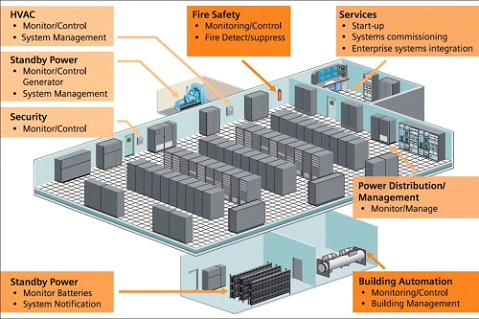
The hosts above depend on the building around them. Heating, ventilation and air conditioning (HVAC) in each data centre uses full particle filtering and humidity control, and the climate is kept within ASHRAE guidelines for IT equipment.
Each site has on-site diesel generators and uninterruptible power systems (UPS). They are tested regularly so they perform as designed in a real outage. The buildings are locked and guarded, watched by closed-circuit television, and entered with pass cards and biometric fingerprint scanners; only authorised CACloud staff reach the equipment.
The per-building facts, including fire suppression and meet-me rooms, are on the data centres page.
Need a specific hypervisor or storage layout?
Tell us what the application is certified for and how it stores data. An engineer will confirm which product line matches before you order, and quote anything that needs a custom build.